To the End of Revolution by Xiaoyuan Liu
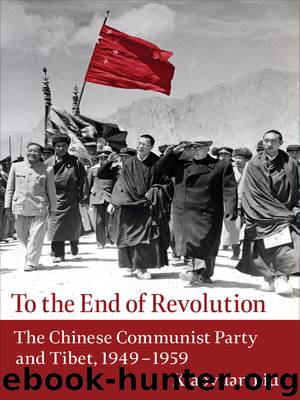
Author:Xiaoyuan Liu
Language: eng
Format: epub
Tags: HIS008000, History/Asia/China, POL054000, Political Science/World/Asian
Publisher: Columbia University Press
Published: 2020-07-07T00:00:00+00:00
Besides reassuring the Dalai Lama that reform would not reach Tibet any time soon, Zhou also refuted an idea attributed to the Dalai Lama’s brothers that the Tibetans might receive assistance from India or the United States for achieving independence. Zhou told the Dalai Lama and his officials that Nehru maintained a friendly relationship with the PRC, recognized Tibet as part of China, and did not permit any anti-Chinese activities in Indian territories. As for the United States, the idea of American assistance was but a hoax. The United States was far away and could not airlift aid materials to Tibet over the air space of India. So, the Americans could only brag with empty words. Zhou went a step further in describing a prospect for the Dalai Lama should he still decide to stay abroad. Perhaps having in his mind a Chinese proverb, “The monk can run away but the temple cannot” (paodeliao heshang paobuliao miao), Zhou reasoned that since the Dalai Lama’s temple was in Lhasa, if he stayed abroad, the Dalai Lama would not only lose political influence inside Tibet but also his “divine air.” Admitting that the Dalai Lama would be valuable to the PRC’s adversaries if he were willing to curse the Chinese Communists, Zhou nevertheless predicted that such value would dwindle over time.39
While trying different angles of reasoning to persuade the Dalai Lama and his officials to return to Lhasa, Zhou regarded the Indian prime minister Nehru as an even more important target because Nehru could deny asylum to the Dalai Lama. However, Zhou made an erroneous judgment about Nehru, and his attempts at persuasion would prove costly to the Chinese-Indian relationship a few years later. As shown in Nehru’s conversations with the Dalai Lama in November 1956, from the outset he did not harbor any intention of keeping the Dalai Lama in India. Zhou, however, was suspicious. The Dalai Lama seemed to confirm that suspicion when he told Zhou in November that he sensed a great “pulling force” from the Indian side.40 On December 31, 1956, and January 1, 1957, Zhou and Nehru held long talks. Since the records kept by the Chinese side remain classified, the contents of these conversations can be known only through published Indian records. The two leaders started their conversation with a lengthy discussion of recent developments in the Middle East and East Europe. But the focus of the conversation soon shifted.41 Clearly, Tibet was the most important issue on Zhou’s mind. At one point, Nehru mentioned that in his recent visit in the United States President Eisenhower had indicated a willingness to allow American journalists to visit the PRC if Beijing would release the ten American prisoners from the Korean War. Zhou did not want to pursue this topic without first reaching an understanding with Nehru about Tibet. In a long monologue that followed, Zhou described Tibet’s historical relationship with China, Beijing’s policy of giving “a large measure of autonomous rights” to Tibet, and Beijing’s current “attitude of waiting and seeing” toward the issue of improving conditions of the region.
Download
This site does not store any files on its server. We only index and link to content provided by other sites. Please contact the content providers to delete copyright contents if any and email us, we'll remove relevant links or contents immediately.
| Arms Control | Diplomacy |
| Security | Trades & Tariffs |
| Treaties | African |
| Asian | Australian & Oceanian |
| Canadian | Caribbean & Latin American |
| European | Middle Eastern |
| Russian & Former Soviet Union |
The Secret History by Donna Tartt(19291)
The Social Justice Warrior Handbook by Lisa De Pasquale(12222)
Thirteen Reasons Why by Jay Asher(8993)
This Is How You Lose Her by Junot Diaz(6954)
Weapons of Math Destruction by Cathy O'Neil(6362)
Zero to One by Peter Thiel(5863)
Beartown by Fredrik Backman(5838)
The Myth of the Strong Leader by Archie Brown(5550)
The Fire Next Time by James Baldwin(5501)
How Democracies Die by Steven Levitsky & Daniel Ziblatt(5271)
Promise Me, Dad by Joe Biden(5189)
Stone's Rules by Roger Stone(5129)
A Higher Loyalty: Truth, Lies, and Leadership by James Comey(5017)
100 Deadly Skills by Clint Emerson(4968)
Rise and Kill First by Ronen Bergman(4833)
Secrecy World by Jake Bernstein(4795)
The David Icke Guide to the Global Conspiracy (and how to end it) by David Icke(4770)
The Farm by Tom Rob Smith(4546)
The Doomsday Machine by Daniel Ellsberg(4538)
